dk@dkoutsource.com


Construction disputes have long been associated with extensive documentation, lengthy correspondence, competing claims, and significant commercial costs. As the built environment becomes increasingly digital, technology is fundamentally changing how these disputes are identified, investigated, and resolved.
From cloud-based document management to artificial intelligence, modern digital tools help contractors, consultants, developers, and legal professionals manage project evidence more efficiently. While technology does not replace professional human judgement, it provides a powerful platform for faster, more transparent, and evidence-based dispute resolution.
The Evolution of Digital Evidence
Construction projects naturally generate vast amounts of information, including contracts, payment records, emails, photographs, site reports, project programmes, invoices, and general correspondence. When this information is spread across disconnected systems, finding critical documents becomes a major administrative challenge.
Construction dispute resolution refers to the processes used to resolve disagreements arising from construction projects, including disputes involving delays, costs and contractual issues. -RICS
Digital platforms address this issue by centralising project records, making them easier to search, organise, and retrieve. Cloud-based project logs and time-stamped digital records provide an objective history of when decisions were made and what information was available to parties at that time. This capability is highly valuable for construction claims, where establishing a clear, factual chronology often directly influences the outcome. Consequently, electronically stored information—including cloud records and other digital evidence—is playing an increasingly vital role in modern construction arbitration.
Artificial Intelligence and Dispute Analysis
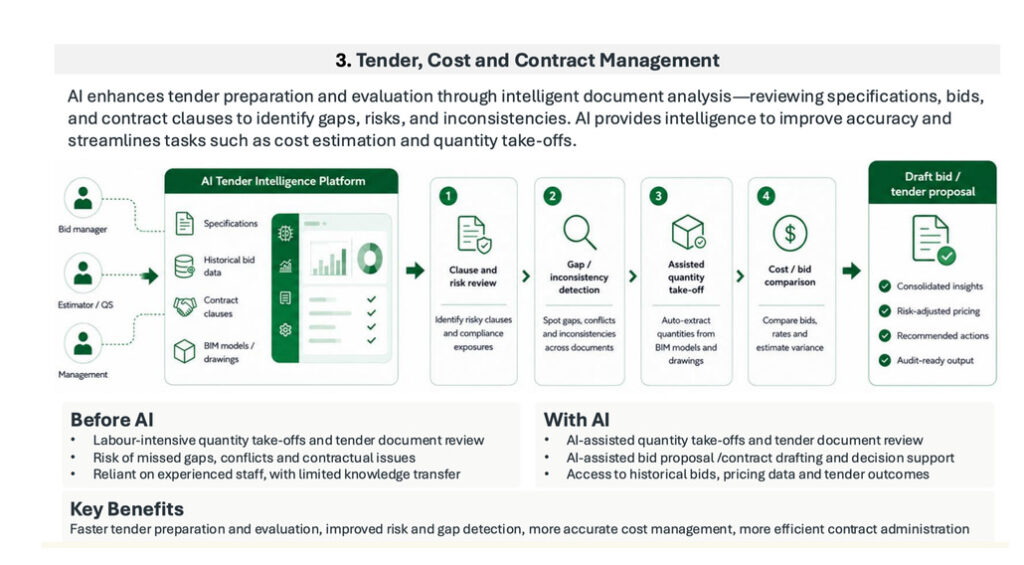
Artificial intelligence is beginning to play an active role in analyzing construction claims. AI-powered systems can process immense volumes of unstructured project information and identify underlying trends or patterns that would be extremely difficult to detect through manual reviews.
Artificial intelligence (AI) are digital systems capable of performing tasks requiring human-like intelligence, such as learning, reasoning and inferring. -RCIS
The Royal Institution of Chartered Surveyors (RICS) has highlighted how AI can assist professionals with delay analysis, examine complex project records, and identify the root causes of site disruptions. This data-driven analysis supports the objective assessment of disruption impacts to provide clear insights during a dispute. However, because construction disputes frequently involve complex contractual interpretation, technical judgement, and unique site circumstances that cannot be understood from data alone, AI must be treated as an analytical assistant rather than a replacement for experienced professionals.
Digital Cost Evidence and Quantity Surveying
When a dispute involves numerous variation claims, having structured digital records makes it much easier to prove what changed, when the change occurred, and how it affected project costs.
| Construction dispute | Digital evidence that may be relevant | How it helps |
| Variation claims | Revised drawings, instructions, variation records and cost estimates | Helps establish what changed, when the change occurred and its financial impact |
| Payment disputes | Progress claims, payment responses, valuations and supporting documents | Creates a structured record of amounts claimed, assessed and paid |
| Delay claims | Project programmes, site records, correspondence and time-stamped updates | Helps establish the sequence and timing of events |
| Defect claims | Site photographs, inspection reports and defect records | Helps establish the condition of works and when issues were identified |
| Loss and expense claims | Cost records, invoices, labour records and project correspondence | Provides supporting evidence for additional costs claimed |
Financial disagreements represent a primary driver of construction disputes. Resolving conflicts over variations, interim valuations, progress payment claims, loss and expense, and final accounts requires highly reliable and structured financial evidence.
This is where professional Quantity Surveying (QS) services are essential. Digital cost management systems enable quantity surveyors to organise financial records, compare original contract sums against actual expenditures, and trace design and scope changes throughout the project lifecycle. When a dispute involves numerous variation claims, having structured digital records makes it much easier to prove what changed, when the change occurred, and how it affected project costs. This objective financial trail strengthens both claims and counterclaims while reducing reliance on fragmented spreadsheets and manual record assembly.

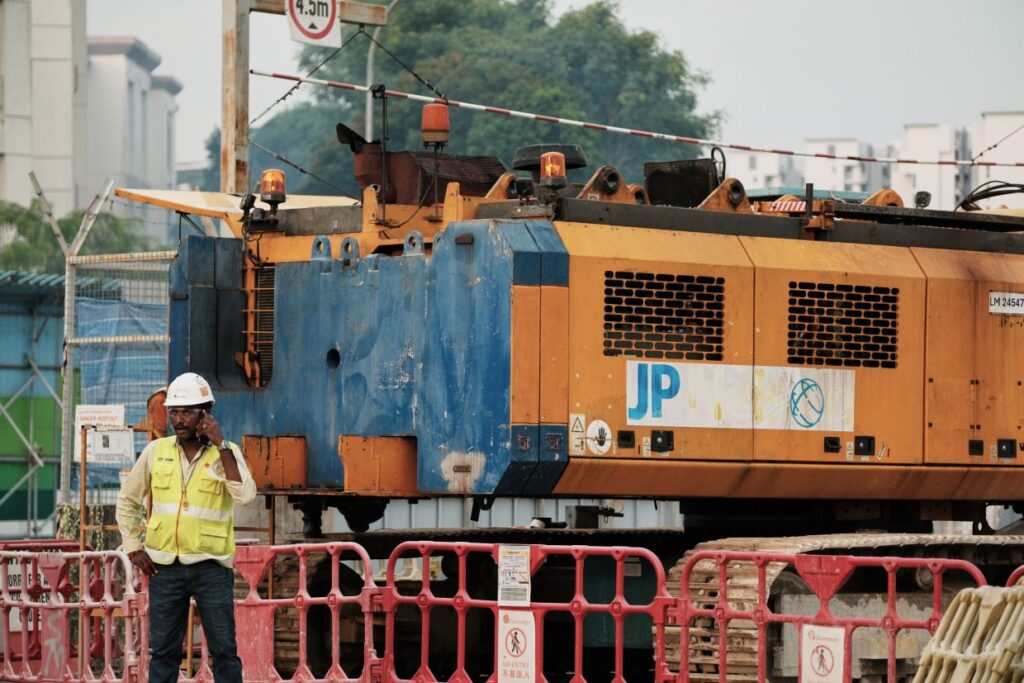
Picture from Pixabay
Technology in Singapore’s Dispute Framework
Singapore provides a leading example of how digital evidence integrates with established statutory and alternative dispute resolution pathways. The Building and Construction Authority (BCA) administers the Building and Construction Industry Security of Payment Act (SOP Act), which provides a statutory right to progress payments and a fast-track adjudication mechanism for payment disputes.
Within this framework, digital records are highly valuable, helping parties compile, organise, and present their payment claims, payment responses, and supporting evidence within strict statutory timelines. Furthermore, Singapore’s courts actively recognise the growing technical complexity of construction disputes, and the Singapore Construction Mediation Centre (SCMC), established under the Singapore Contractors Association Limited (SCAL), strongly promotes confidential and practical mediation to resolve disagreements collaboratively.
De-risking Modular Construction Supply Chains
The growing adoption of modular construction—which relies heavily on prefabricated, prefinished volumetric components—creates unique challenges that benefit from digital dispute management. Because modular projects involve manufacturers, suppliers, transport providers, and site installation teams working across different physical locations, identifying where an issue arose can be difficult.
Digital tracking systems allow project teams to monitor production, quality control inspections, logistics, and site installation in real time. If a component is delayed, damaged, or fails to meet design specifications, this clear digital trail establishes exactly where the issue occurred and which contracting party is contractually responsible. This high level of traceability is exceptionally valuable for managing the risks associated with complex supply chains and multi-party contractual relationships.
The Challenge of “Too Much Evidence”
While technology simplifies document retrieval, it also introduces a modern challenge: information overload. A larger volume of digital records does not automatically make a dispute easier to resolve, and excessive data can obscure key issues.
Effective dispute resolution still requires experienced professionals to determine which pieces of evidence are contractually relevant, legally reliable, and commercially proportionate. Professional expertise remains completely indispensable to this process, as reflected in the strict professional standards maintained by RICS for individuals acting as adjudicators, arbitrators, and independent experts in construction disputes.
Following the Digital Evidence Trail
Technology will not eliminate construction disputes; changes, schedule delays, payment disagreements, and physical defects will continue to occur across the global built environment. However, what digital tools do provide is a clearer, more objective path to understanding and resolving them.
By combining digital records to establish facts, AI to analyse disruption, and digital cost systems to secure financial evidence, project teams can resolve conflicts with greater speed and transparency. Ultimately, the future of the industry is not about replacing professional technical, legal, and commercial expertise, but about equipping those professionals with stronger evidence and greater confidence to resolve disputes efficiently.
References
Building and Construction Authority (BCA) — Singapore’s Security of Payment framework and construction dispute mechanisms. https://www1.bca.gov.sg/growth-and-transformation/procurement/procurement-and-legal-frameworks/security-of-payment-act/
Singapore Contractors Association Limited (SCAL) https://www.scal.com.sg/scmc
Singapore International Arbitration Centre (SIAC) — Singapore’s international arbitration framework and developments in technology-assisted dispute resolution. https://siac.org.sg/
RICS — International professional guidance on construction adjudication, arbitration, expert evidence and dispute resolution. https://www.rics.org/profession-standards/rics-standards-and-guidance/sector-standards/dispute-resolution-standards
ScienceDirect — An academic source for research into digital technologies and construction dispute resolution, giving the article stronger research credibility. https://www.sciencedirect.com