dk@dkoutsource.com

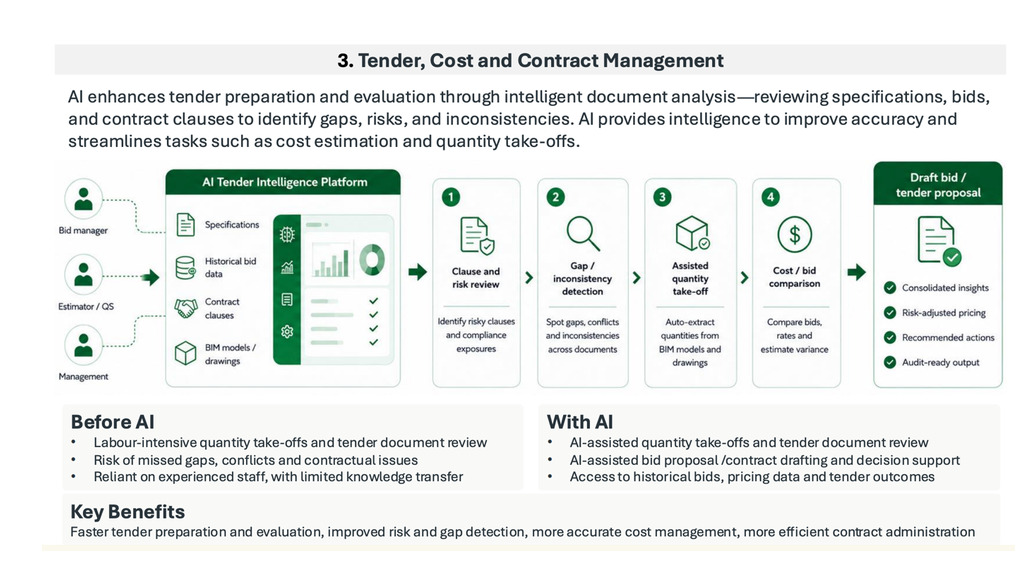
Summary: The AI Tender Intelligence Platform transforms manual procurement into a data-driven workflow. It executes four core processes: automated clause and risk reviews, cross-document gap detection, assisted quantity take-offs from drawings/BIM, and cost/bid comparisons. This mitigates contractual risk while accelerating accurate tender preparation.
Strategic Overview of the AI Tender Intelligence Platform
In the modern construction and procurement landscape, the transition from fragmented document review to an integrated AI Tender Intelligence Platform represents a fundamental shift in operational strategy. Historically, tendering has been a siloed, manual administrative burden. By digitising this workflow, organisations move beyond basic paperwork to a model of high-value decision support. This evolution enables the Bid manager, Estimator / QS, and Management to focus on strategic positioning rather than being bogged down by the minutiae of document processing, ensuring that every bid is underpinned by rigorous, data-driven intelligence.
The foundation of this platform rests on four primary input categories that provide the necessary context for automated analysis:
- Specifications: These define the technical requirements and standards of the project, serving as the benchmark against which all proposals are measured.
- Historical Bid Data: By leveraging past performance, pricing, and outcomes, the platform provides a baseline for benchmarking, allowing for more informed and competitive forecasting.
- Contract Clauses: Inputting the legal framework ensures that the AI can monitor for compliance and identify potential liabilities hidden within the fine print.
- BIM Models and Drawings: Digital representations of the physical project allow for the extraction of precise spatial and material data, ensuring the tender is grounded in physical reality.
These raw inputs form the essential data layer, enabling the platform to execute the sophisticated analytical steps required for a comprehensive tender workflow.
Step 1: Automated Clause and Risk Review
Rigorous legal and compliance oversight is a prerequisite for any successful pre-contract phase. In traditional workflows, the sheer volume of contractual documentation often leads to oversight, where critical liabilities are only discovered after the contract is signed. An AI-enhanced approach automates the identification of risky clauses and compliance exposures, ensuring that every line of a contract is scrutinised against established safety and legal parameters.
The “So What?” of this automation is found in its ability to mitigate risk at scale. By moving away from manual, page-by-page reading, the organisation significantly reduces the likelihood of human error—the primary cause of legal oversights. This proactive detection ensures that high-risk terms are flagged for negotiation before they become binding commitments. Identifying these specific, isolated clauses is only the first stage; it sets the foundation for detecting broader inconsistencies across the entire project suite.
Step 2: Gap and Inconsistency Detection
Managing the vast array of documents required for a major project is inherently complex. Information is often distributed across different files, and the risk of conflicting data is high. The AI platform addresses this by “spotting gaps, conflicts, and inconsistencies across documents,” providing a layer of cross-document intelligence that is impossible to achieve manually in a time-sensitive environment.
The contrast between the old and new methods is stark. Before AI, the risk of missed conflicts was a constant threat to bid accuracy. With AI, the system cross-references every document simultaneously, ensuring that a specification in one file does not contradict a requirement in another. This level of integrity is a critical differentiator, ensuring that the bid is not only compliant but internally consistent. Once the logical integrity of the documentation is verified through cross-referencing, the platform shifts its intelligence from text-based reconciliation to the verification of spatial accuracy and physical quantities.
Step 3: Assisted Quantity Take-Off
Traditional quantity surveying is notoriously labour-intensive, often acting as a bottleneck in the bidding cycle. In a competitive market, speed and precision are strategic assets. The AI-enhanced process introduces “Assisted Quantity Take-Off,” which utilizes sophisticated neural networks to auto-extract quantities directly from BIM models and drawings. This process bridges the gap between 2D drawings or 3D BIM models and the final Bill of Quantities (BoQ) by interpreting spatial and material data to calculate volumes and areas instantly.
The shift in workflow provides a significant advantage over manual methods:
- From Manual Measurement to AI-Driven Extraction: Instead of surveyors manually measuring dimensions, the AI interprets spatial data to generate instant, accurate extractions.
- Reduction of Human Error: Automated extraction eliminates the fatigue-related mistakes common in repetitive manual calculations, ensuring the BoQ is grounded in precise data.
- Optimised Professional Focus: By automating the “grunt work” of measurement, the Estimator and QS are empowered to focus on high-value cost engineering and value management.
These extracted quantities provide the raw numerical data that must then be transformed into financial intelligence during the comparison phase.
Step 4: Cost and Bid Comparison
The final analytical step involves ensuring that the tender is priced accurately against both internal benchmarks and external market conditions. This phase focuses on comparing bids, rates, and estimating variance to ensure financial viability.
The “So What?” of this stage is the ability to produce a data-backed financial submission. By accessing historical bids, pricing data, and previous tender outcomes, the AI allows estimators to see how current rates compare to past performance. This enables the organisation to submit bids that are competitive enough to win but robust enough to remain profitable, avoiding the pitfalls of under-pricing or over-estimating. With the financial data verified and compared, the system moves into the final stage of generating the definitive tender output.
Comparative Analysis: Evolution of the Workflow
The transition from traditional to AI-assisted workflows marks a fundamental shift in professional capability, moving from reactive administration to proactive intelligence.
| Feature | Before AI | With AI |
| Workload | Labour-intensive quantity take-offs and tender document review. | AI-assisted quantity take-offs and tender document review. |
| Risk Profile | High risk of missed gaps, conflicts, and contractual issues. | Improved detection of gaps and conflicts through automated cross-referencing. |
| Knowledge Management | Reliant on experienced staff with limited knowledge transfer. | AI-assisted bid proposal / contract drafting and decision support; access to historical bids, pricing data, and tender outcomes. |
These cumulative differences ensure that the final proposal is more accurate, more competitive, and more resilient to risk.
Analysis of the Final Deliverable: The Draft Bid and Tender Proposal
The ultimate output of this four-step process is the “Draft bid / tender proposal.” This is not merely a document, but a synthesis of all the analytical intellige
nce gathered throughout the workflow, formatted to facilitate rapid executive decision-making.
The output consists of four specific components:
- Consolidated Insights: These provide management with a holistic view of the project, summarising the findings from both document and quantity reviews.
- Risk-Adjusted Pricing: This ensures that the final price reflects the specific risks and inconsistencies identified in Steps 1 and 2, providing a realistic financial buffer.
- Recommended Actions: These act as a strategic guide, highlighting specific steps management should take to address remaining gaps or negotiation points.
- Audit-Ready Output: To maintain professional standards, the output is transparent and traceable, ensuring that all data points can be verified during internal or external audits.
This comprehensive package ensures that the final submission is ready for executive review and client presentation, providing a clear path from data to contract award.
Summary of Key Organisational Benefits
Adopting an AI-enhanced tender and contract management process provides a significant cumulative advantage, transforming how an organisation handles its most critical commercial tasks.
- Faster Tender Preparation and Evaluation: Accelerating the cycle allows the organisation to respond to more opportunities without increasing headcount, increasing market share.
- Improved Risk and Gap Detection: Identifying liabilities early protects the organisation’s bottom line from unforeseen legal and operational costs during the project lifecycle.
- Accurate Cost Management: Precision in take-offs and pricing benchmarks ensures that projects remain profitable and that variance is controlled from the outset.
- Efficient Contract Administration: This streamlines the transition from bid to delivery, significantly reducing the likelihood of post-award disputes and claims while allowing staff to focus on client relationships.
The integration of AI into tender management is no longer a luxury but a necessity for organisations seeking to maintain a competitive edge. By combining historical data with real-time document intelligence, the future of AI-led tender management ensures that every bid is a strategic, data-supported step toward project success.
References
BCA AI use cases for BE, 2026