dk@dkoutsource.com


Picture a consultant quantity surveyor sitting at a desk historically buried under physical architectural drawings, manual measurement sheets, marked-up plans, and printed cost reports. Today, this paper-heavy environment is rapidly being replaced by a single laptop, digital drawing files, Building Information Modelling (BIM) systems, and integrated cost management platforms.
Going paperless does not mean abandoning the core principles of quantity surveying. Instead, it represents a strategic shift—using advanced technology to streamline traditional workflows, making quantity take-off, cost estimation, cost planning, tendering, procurement, and cost control faster, more connected, and highly collaborative. As modern construction projects grow increasingly complex, digital workflows are fundamentally reshaping how quantity surveyors operate and how clients receive commercial cost management services.
Consultant Quantity Surveyor provides independent cost and commercial advice to clients on construction projects, covering areas such as cost planning, procurement, tendering, contract administration, cost control and valuations. -RICS
From Measuring Drawings to Analysing Digital Information
For generations, quantity surveyors have relied on physical rules and manual calculations to extract quantities from paper plans. While precise measurement remains a foundational skill, digital tools have dramatically changed how data is extracted and analysed.
At the heart of this shift is Building Information Modelling (BIM). The Royal Institution of Chartered Surveyors (RICS) provides specific guidance on how cost managers can leverage data directly from BIM models to generate measurement outputs. This means BIM is no longer treated solely as a 3D design tool; it is now a core component of the quantity surveying and cost planning workflow. Working with structured digital information removes tedious manual sorting, allowing the QS to focus on high-value data analysis rather than administrative extraction.
More Than a Digital Calculator: The Strategic Advisor
A common misconception is that going digital simply means swapping a physical calculator for software. In reality, the role of a modern consultant quantity surveyor is highly strategic.
Beyond producing quantities, a professional QS provides vital advice on:
- Early-stage cost planning and estimation
- Strategic procurement and tender evaluations
- Contract administration and robust project controls
- Objective variation assessments and cost control
- Active commercial risk management
According to RICS research into technology in cost management, adopting data-driven, model-centric workflows allows surveyors to significantly improve operational efficiency. By automating repetitive administrative tasks, the QS is freed to spend more time interpreting data, identifying potential cost overruns early, evaluating design changes, reviewing tender pricing, and advising clients on the commercial viability of project specifications.
Cost management is the systematic process of planning, estimating, monitoring and controlling costs throughout the life cycle of a construction project. -AACE International
Singapore’s Built Environment Digital Transformation
Singapore serves as a leading global example of this digital transition in action. The Singapore Institute of Surveyors and Valuers (SISV) has actively highlighted how converging technologies and automated measurement systems are shifting the profession away from traditional bill production and toward a broader cost advisory role. Under this model, technology handles repetitive data processing while the professional focuses on commercial strategy, decision-making, and risk management.
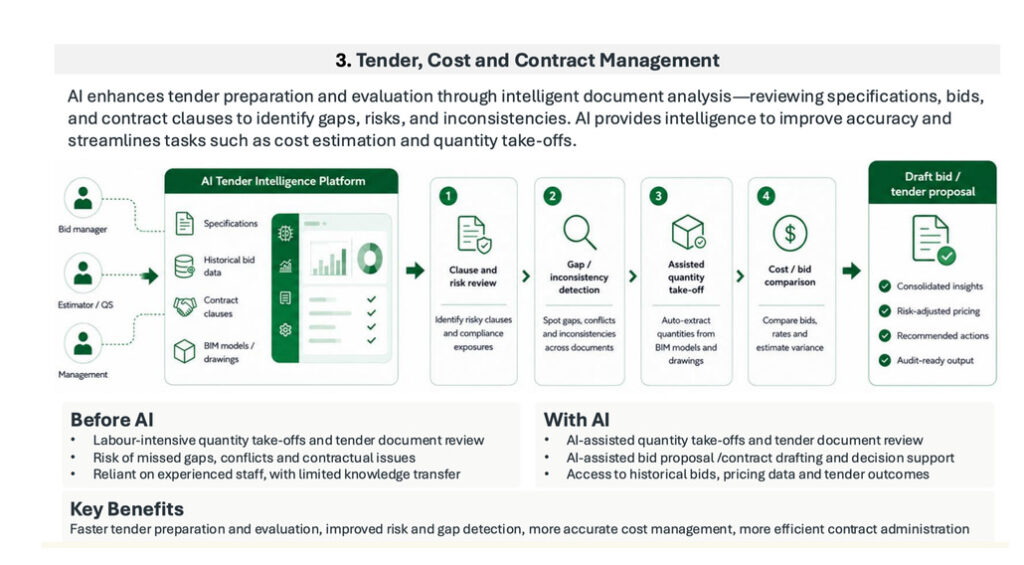
Furthermore, Singapore’s Infocomm Media Development Authority (IMDA) has formally recognized Quantity Surveying and Valuation as a critical digital business capability within its refreshed Built Environment Industry Digital Plan. This digital roadmap prioritizes the integration of BIM, digital platforms, workflow automation, and AI-driven decision support systems directly into professional construction services.

Picture by Thirdman on Unsplash
Dynamic Cost Reporting and Visualisation
Traditional cost reporting often involves managing a disconnected paper trail of spreadsheets, variation sheets, and manual forecasts. Modern digital cost management consolidates these records into a single, connected platform. To improve communication, RICS highlights interactive data visualisation as a key opportunity to make financial reporting more timely, transparent, and dynamic.
Interactive data visualisation refers to graphical representations of data that allow users to interact with the information, such as by filtering, zooming or adjusting the view, to explore and interpret the data. -IMDA
By replacing static spreadsheets with interactive dashboards, quantity surveyors can present forecast construction costs clearly. This gives clients absolute visibility over their project’s financial health and allows the QS to spend less time compiling records and more time explaining what the financial data actually means.
The Indispensable Value of Human Judgement
While digital tools offer immense efficiency, they do not replace professional human expertise. Technology is an aid, not a substitute for professional judgement. In practice:
- Automated quantity take-offs still require rigorous professional checks.
- Cost databases cannot automatically understand unique, project-specific site conditions.
- Software lacks the capacity to independently understand a client’s specific commercial priorities.
For these reasons, the future of quantity surveying relies on combining advanced digital tools with experienced human oversight. RICS professional standards continue to champion digital tools for cost prediction and control while emphasizing that strategic commercial decisions must always be guided by qualified, professional human expertise.
The Bottom Line
The consultant quantity surveyor who ditches paper is not abandoning their profession; they are simply eliminating manual, inefficient workflows. Drawings become digital models, measurements become automated take-offs, and cost reports become interactive dashboards. While the medium has evolved, the core responsibilities remain unchanged: delivering exceptional cost planning, cost control, procurement advice, and commercial risk management. For developers and clients, the modern QS is no longer just a measurer of bricks—they are a vital commercial partner providing the data-driven, strategic advice needed to deliver successful paperless construction projects.
References
- RICS — Role and Importance of Data and Technology in Quantity Surveying and Cost Management Practice https://www.rics.org/content/dam/ricsglobal/documents/research/Data%20and%20tech%20in%20QS%20and%20CM_amended%20Aug%2023.pdf
- IMDA — Built Environment Industry Digital Plan – paperless construction https://www.imda.gov.sg/resources/press-releases-factsheets-and-speeches/factsheets/2024/refreshed-built-environment-idp
- SCAL — The Contractor: Peeking Beyond the “Phygital” Horizon https://scal.com.sg/uploads/files/The%20Contractor%20-%20Newsletter/2022%20SCAL%20Newsletter%20Issue%203.pdf
- Building and Construction Authority — Building Information Modelling (BIM) https://www1.bca.gov.sg/safety-and-standards/lifts-escalators-and-mechanised-car-parking-systems/building-information-modelling-bim\
- Building and Construction Authority — Integrated Digital Delivery (IDD)https://www1.bca.gov.sg/growth-and-transformation/productivity/idd-integrated-digital-delivery/
- SCAL — The Contractor: Job Redesign in the Digital Age https://www.scal.com.sg/uploads/files/The%20Contractor%20-%20Newsletter/SCAL_The%20Contractor%20Issue%202%202021%20%28Online%20version%29%20-%20reduce.pdf
- RICS — Global Cost and Commercial Management https://www.rics.org/content/dam/ricsglobal/documents/standards/rics-and-global-cost-and-commercial-management-1st-edition-rics2.pdf