dk@dkoutsource.com


Construction projects involve an array of highly complex financial decisions, ranging from initial cost estimation and budgeting to procurement, contract administration, and the final account settlement. With constant fluctuations in material prices, labour rates, and subcontractor fees, active and effective cost management is absolutely essential to keeping developments financially viable.
In Singapore’s construction ecosystem, the key professional responsible for managing these financial parameters is the Quantity Surveyor (QS), also known as a construction cost consultant or cost manager. Working collaboratively alongside developers, clients, architects, engineers, contractors, and project managers, the QS monitors and controls expenditures throughout the entire project lifecycle.
What Does a Quantity Surveyor Do?
While architects and engineers focus on design, aesthetics, and structural integrity, a QS is responsible for managing the financial and commercial aspects of the build. Their involvement frequently begins long before construction starts, playing a pivotal role in helping clients assess whether a proposed development is financially feasible.
During these early planning stages, a QS prepares preliminary cost estimates, cost plans, and project budgets. As design drafts develop, they continuously evaluate how design decisions, material selections, technical specifications, and proposed construction methodologies will affect overall project costs.
According to the Royal Institution of Chartered Surveyors (RICS), a QS may be involved across a wide spectrum of project needs, including:
- Cost planning, budgeting, and commercial management.
- Procurement, tendering, and contract administration.
- Lifecycle costing and active expenditure monitoring to identify potential savings.
This comprehensive oversight makes the QS an invaluable asset, ensuring developers possess accurate financial information before committing to major construction milestones.
Who Provides Construction Cost Management Services?
In the construction industry, cost management services are typically divided into two categories based on representation.
A Consultant Quantity Surveyor (QS) is a construction professional who manages the financial and contractual aspects of building and engineering projects, helping to keep them within budget while delivering value. -SISV
1. Consultant Quantity Surveyors (Client Side)
Consultant QS professionals are independently appointed by clients and developers to provide objective cost advice and protect the client’s financial interests.
Their extensive scope of services includes:
- Construction cost estimation, planning, and preparing Bills of Quantities (BQ).
- Tender documentation and detailed tender evaluations.
- Procurement advice and active contract administration.
- Independent progress payment assessments and variation valuations.
- Regular cost reporting, claims assessments, final account preparation, and lifecycle costing.
In Singapore’s public sector, Quantity Surveying is formally recognised as one of the five key consultancy disciplines under the Building and Construction Authority’s (BCA) Standard Consultancy Agreement, alongside architecture, civil & structural engineering, mechanical & electrical engineering, and project management. This formal recognition highlights the critical role cost control plays in Singapore’s built environment.
2. construction cost management services (Builder Side)
Unlike consultant QSs who represent the client, contractors and subcontractors employ their own Quantity Surveyors or commercial managers to safeguard the builder’s commercial position. A contractor’s QS focuses on monitoring subcontractor costs, preparing progress payment applications, assessing variation orders, managing commercial risks, and tracking overall project profitability.
Having distinct QS professionals representing different sides of the contract ensures balanced financial oversight and commercial transparency throughout the project.

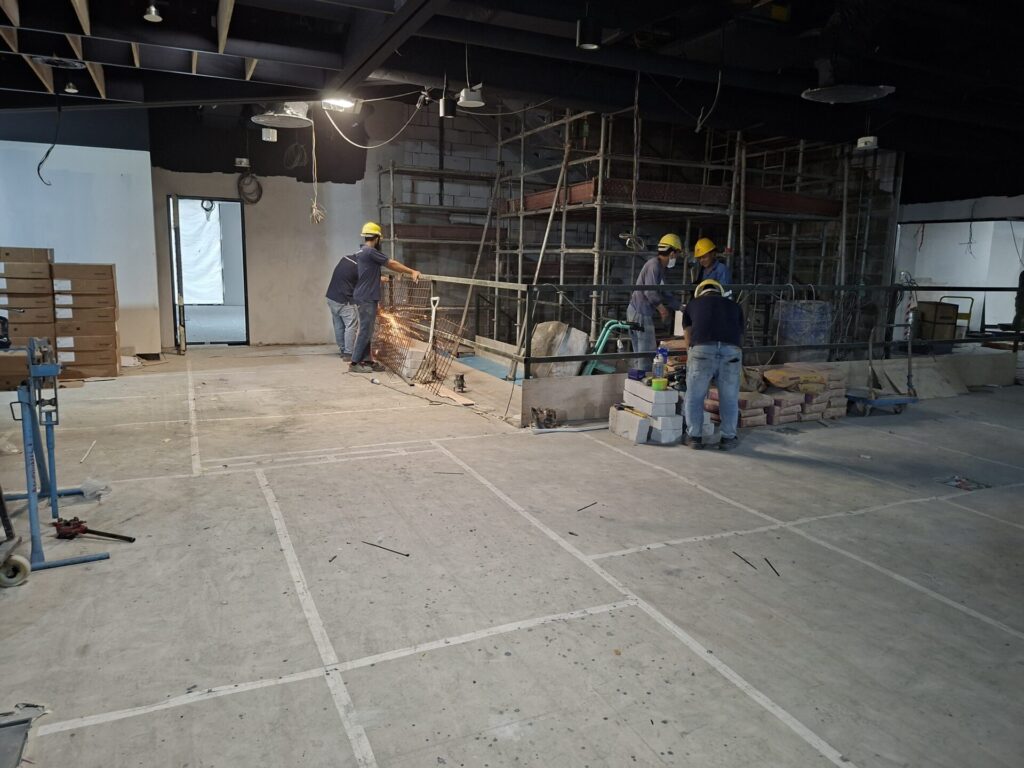
Picture by Nishantan on pexels
Cost Management in Action: The Construction Phase
Active cost control becomes highly critical once physical works begin on-site, as any unmanaged deviations from drawings, materials, specifications, or site conditions can quickly inflate budgets.
For example, consider a commercial development in Singapore where the client decides to upgrade the building’s façade materials mid-construction. This modification can trigger a cascade of changes, affecting direct material costs, labour requirements, procurement schedules, and the overall construction programme.
In this scenario, a consultant QS evaluates the proposed variation order, determines its exact financial impact, and advises the client before the change is approved. By routinely measuring completed work, reviewing progress payments, and preparing structured cost reports, the QS enables stakeholders to compare actual expenditures against the baseline budget to catch and resolve potential cost overruns early.
Why Cost Management is Critical in Singapore
Singapore boasts a highly active and sophisticated built environment, with projects spanning complex residential developments, commercial high-rises, healthcare facilities, industrial hubs, and massive public infrastructure. Key urban redevelopments—such as plans to connect Istana Park, Dhoby Ghaut Green, and Penang Road Open Space with a pedestrianised stretch of Orchard Road—illustrate the scale of Singapore’s ongoing urban transformation.
The financial scale of these works is immense. The BCA projected Singapore’s total construction demand to reach between S$47 billion and S$53 billion for 2025, driven by landmark projects like Changi Airport Terminal 5, the Marina Bay Sands expansion, public housing developments, healthcare infrastructure, and expanding MRT networks. Furthermore, BCA expects construction demand to remain strong, averaging between S$39 billion and S$46 billion annually from 2026 to 2029.
Operating at this magnitude means that even minor fluctuations in material quantities, labour rates, or variation orders can result in significant financial consequences. Professional cost management is therefore vital to helping clients establish realistic budgets, choose optimal procurement strategies, and make informed commercial decisions.
Technology and Modern Quantity Surveying
The quantity surveying profession is evolving rapidly with the adoption of digital take-off tools, Building Information Modelling (BIM), advanced estimating software, cloud-based collaboration platforms, and data analytics. These technologies allow QS professionals to process information and measure quantities with unprecedented speed and efficiency.
However, digital tools do not replace professional human judgement. Construction projects involve complex contractual requirements, volatile market conditions, sudden design modifications, and commercial risks that demand experienced, human interpretation. Combining modern digital tools with the specialised expertise of a consultant QS delivers the strongest approach to cost management—utilising technology to streamline data processing while relying on experienced professionals to provide strategic commercial advice.
References
- Royal Institution of Chartered Surveyors (RICS) – What is a Quantity Surveyor? https://www.rics.org/surveyor-careers/surveying/what-surveyors-do/what-is-a-quantity-surveyor
- Building and Construction Authority (BCA) – Standard Consultancy Agreement https://www1.bca.gov.sg/growth-and-transformation/procurement/standard-contract-forms/standard-consultancy-agreement/
- Building and Construction Authority (BCA) – Construction Demand to Remain Strong for 2025 https://www1.bca.gov.sg/resources/newsroom/construction-demand-to-remain-strong-for-2025/
- Building and Construction Authority (BCA) – Public Sector Panels of Consultants https://www1.bca.gov.sg/growth-and-transformation/procurement/
- Building and Construction Authority (BCA) – Procurement Frameworks and Contract Forms https://www1.bca.gov.sg/growth-and-transformation/procurement/