dk@dkoutsource.com

In the modern construction industry, project disputes can rapidly spiral into costly and time-consuming deadlocks, putting immense strain on cash flow and severely damaging relationships between clients, contractors, subcontractors, and consultants. Disagreements typically arise over complex issues such as construction contracts, payment claims, variation orders, project delays, defects, valuations, and extensions of time (EOT).
As projects grow larger and more complex, combining artificial intelligence (AI) with professional quantity surveying (QS) expertise offers a practical, modern approach to identifying risks early and supporting more informed dispute resolution.
Crucially, AI is designed to support—not replace—professional human judgement. According to a survey by the Royal Institution of Chartered Surveyors (RICS), 67% of quantity surveying and construction professionals believe AI will help surveyors deliver greater value in the future, while simultaneously emphasizing the critical importance of human oversight and professional accountability.
Professional judgement involves applying a surveyor’s knowledge, skills, reasoning, experience and professional scepticism when assessing information and making decisions. -RICS
Early Detection of Dispute Risks with AI
Many construction disputes do not appear overnight; they develop gradually. A delayed instruction, for instance, can quietly evolve into a contested variation claim, which subsequently disrupts the project programme and ultimately results in a full-blown dispute over EOT and loss and expense.
Artificial intelligence (AI) refers to systems that can perform tasks that would previously have required human cognitive abilities, such as reasoning, decision-making, learning and problem-solving. RICS notes that AI systems used in surveying can produce outputs that are not fully predictable or explainable, which makes professional oversight important. -RICS
AI tools excel at analysing massive volumes of project information far more rapidly than manual review.
On large-scale projects where thousands of documents are generated across the project lifecycle, AI can scan:
- Construction contracts and tender documents
- Project correspondence and email trails
- Meeting minutes and site records
- Payment records and cost reports
By cross-referencing these files, AI can flag conflicting information, missing documentation, or problematic contract clauses that require closer professional investigation. While this analysis does not determine the legal validity of a claim, it serves as a powerful diagnostic tool that highlights vulnerabilities for QS professionals to investigate.
Empowering Quantity Surveyors with Advanced Analysis
A consultant quantity surveyor is responsible for cost management, contract administration, procurement, valuations, and commercial risk. When a dispute arises, the QS must reconstruct the project history to establish what happened, when it occurred, and the precise financial impact.
AI acts as an analytical partner, organizing unstructured data and identifying key patterns across various sources, including:
| Project task | AI can assist with | QS professional role |
| Document review | Identify relevant clauses, correspondence and records | Determine which contractual provisions are relevant |
| Cost analysis | Detect unusual figures, patterns or discrepancies | Assess whether the figures are commercially and contractually appropriate |
| Variation assessment | Cross-reference instructions, quantities and payment records | Verify entitlement and determine the appropriate valuation |
| Claims review | Organise supporting documents and identify gaps | Assess the strength of the claim and supporting evidence |
| Dispute preparation | Build timelines and group relevant project records | Interpret the contract, evidence and financial consequences |
| AI outputs | Flag potential risks or inconsistencies | Check reliability and apply professional judgement |
For example, if an AI system detects a discrepancy between an approved variation order and a subsequent progress payment claim, it flags the issue. A consultant QS can then verify the underlying source documents, assess the contractual entitlement, and determine the appropriate valuation. This human-AI synergy is essential: AI handles the rapid processing of massive datasets, while the experienced QS provides the vital understanding of construction contracts, measurement rules, valuation principles, and commercial realities.
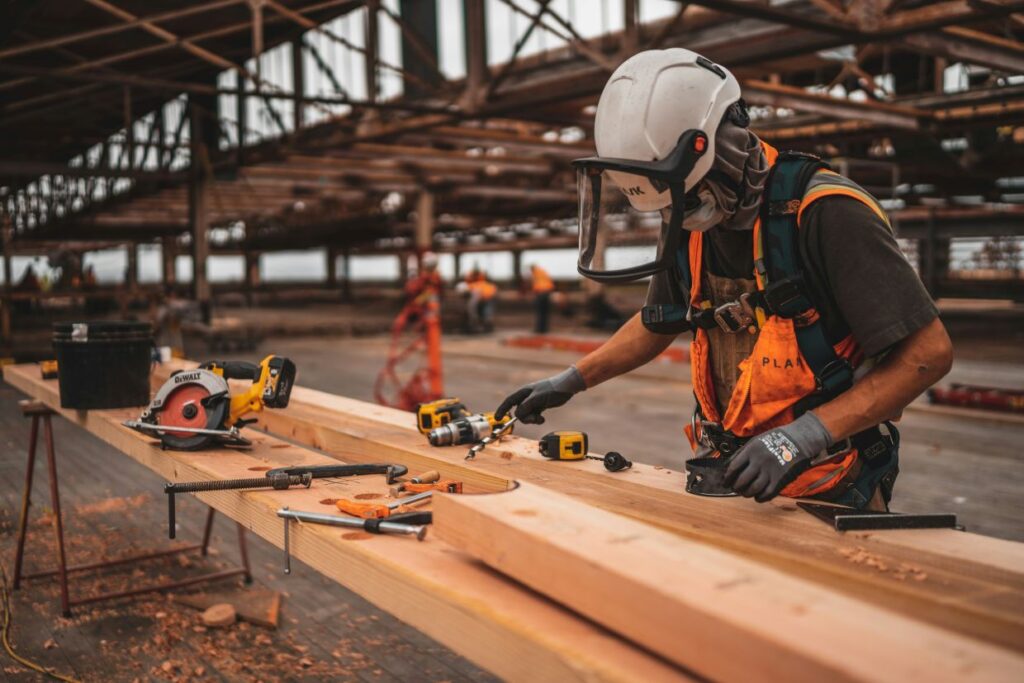
Picture by Jeriden Villegas on Unsplash
Preventing Disputes from Becoming Entrenched Deadlocks
The greatest value of combining AI and QS expertise lies in preventing minor disagreements from escalating into entrenched deadlocks. Consider a common scenario on a construction site—such as in Singapore—where a contractor submits a substantial variation claim following late design modifications. The client, consultants, and contractor might maintain conflicting records of instructions, quantities, and agreed rates. If the issue remains unresolved over several payment cycles, adversarial relationships begin to form.
An AI-supported workflow can automatically cross-reference the architect’s instructions, design drawings, site records, cost reports, and payment applications to pinpoint exactly where the records conflict. Armed with this data, the consultant QS can prepare a structured, objective assessment.
Rather than arguing broadly over subjective entitlements, the parties can focus on six precise, evidence-based questions:
- What instruction was issued?
- When was the work carried out?
- What quantities were affected?
- What contractual mechanism applies?
- What rate should be used?
- What supporting evidence exists?
Grounding the discussion in clear, structured evidence makes negotiations and mediation far more productive.
Responsible AI Governance and Professional Standards
Singapore serves as an excellent example of why technological adoption must be paired with strict professional accountability. The Building and Construction Authority (BCA) provides standard consultancy agreements for public sector construction-related services, including quantity surveying and project management, establishing clear frameworks for professional responsibility.
Furthermore, Singapore’s Infocomm Media Development Authority (IMDA) has established clear principles for responsible AI deployment, emphasizing transparency, risk management, and human-in-the-loop oversight. The IMDA’s 2026 Model AI Governance Framework for Agentic AI explicitly stresses the necessity of meaningful human accountability and checkpoints for human approval. For the construction industry, this means AI-generated findings must always be treated as an analytical aid rather than an automated contract decision.
Ultimately, construction disputes are highly contextual; a contract clause may interact with other provisions, and the practical realities of a site delay or variation determine how entitlement is assessed. A consultant QS provides the indispensable human layer to interpret these nuances, verify source documents, and apply professional judgement before presenting recommendations. This safeguard aligns with RICS’s responsible AI standard, which came into effect in March 2026, highlighting governance, transparency, and professional oversight when AI is used to deliver surveying services.
Establishing a Factual Foundation for Resolution
The goal of combining AI tools with quantity surveying expertise is not to construct a more aggressive argument for one party. Instead, it is to build a clear, indisputable factual foundation for resolving disagreements. By properly organizing cost data, contract documents, project records, and claims, stakeholders can spend less time searching for lost evidence and more time discussing practical commercial solutions.
For developers, contractors, and consultants alike, this collaborative approach enables the early identification of commercial risks, payment disputes, and contract disagreements. It also ensures that project documentation is robustly organized before a matter ever progresses to formal adjudication, arbitration, or litigation. Ultimately, AI is at its most valuable when it strengthens—rather than replaces—professional decision-making, helping construction businesses navigate risks and prevent dispute deadlocks.
References
- RICS – AI in construction dispute resolution Report https://www.rics.org/news-insights/artificial-intelligence-in-construction-report
- RICS – Responsible Use of Artificial Intelligence in Surveying Practice https://www.rics.org/profession-standards/rics-standards-and-guidance/conduct-competence/responsible-use-of-ai
- RICS – Global Standard on Responsible Use of AI in Surveying https://www.rics.org/news-insights/rics-launches-landmark-global-standard-on-responsible-use-of-ai-in-surveying
- Building and Construction Authority – Standard Consultancy Agreement https://www1.bca.gov.sg/growth-and-transformation/procurement/standard-contract-forms/standard-consultancy-agreement/
- IMDA – Model AI Governance Framework for Agentic AI https://www.imda.gov.sg/resources/press-releases-factsheets-and-speeches/factsheets/2026/updated-model-ai-governance-framework-for-agentic-ai
- IMDA – Artificial Intelligence in Singapore https://www.imda.gov.sg/About-IMDA/Research-and-Statistics/SGDigital/tech-pillars/Artificial-Intelligence