dk@dkoutsource.com


Summary: Singapore’s Building and Construction Industry Security of Payment Act (SOPA) helps protect construction industry cash flow by providing statutory rights to progress payments and a fast-track adjudication process for payment disputes. This article explains how the Act works, who it covers and how quantity surveyors can help manage payment risks and contractual obligations.
What Is the Security of Payment Act?
The Building and Construction Industry Security of Payment Act 2004 (SOPA) is Singapore legislation designed to improve cash flow in the construction industry. Effective from 1 April 2005, it provides eligible parties with statutory rights to seek progress payments for construction work carried out or qualifying goods and services supplied under covered contracts.
According to the Building and Construction Authority (BCA), the Act aims to improve cash flow by granting parties the right to seek progress payments and providing a fast, relatively low-cost adjudication mechanism.
Delayed payments can affect contractors, subcontractors and suppliers, particularly those managing tight margins, labour costs and ongoing project expenses.
Who Does the Act Protect?
The Act generally applies to qualifying written construction contracts and supply contracts relating to projects in Singapore, subject to its scope and exclusions.
Eligible claimants may include:
- Main contractors seeking progress payments from project owners.
- Subcontractors claiming payment from main contractors.
- Construction suppliers providing qualifying goods.
- Consultants supplying qualifying construction-related services.
Not every construction agreement automatically falls within the Act. Contract type, project location, statutory definitions and exclusions must be considered. The Act also restricts pay-when-paid clauses in circumstances covered by its provisions, helping protect eligible parties from certain upstream payment delays.
How Does the Payment Claim Process Work?
Understanding the SOPA payment claim process is essential for managing construction payment disputes.
A typical process involves:
- Prepare the payment claim: Identify the contract, claimed amount and supporting breakdown.
- Serve the claim: Follow the applicable contractual and statutory requirements.
- Issue the payment response: The respondent assesses the claim and responds within the relevant timeframe.
- Resolve differences: Parties may clarify valuations and negotiate disputed amounts.
- Apply for adjudication: If statutory conditions are met, the claimant may apply for adjudication.
Key requirements to remember: claim service dates, response deadlines, notice requirements and adjudication application periods. Claims should be supported by clear records, including measurements, progress reports, valuation breakdowns and contractual references. Missing deadlines or failing to comply with procedural requirements may affect a party’s position.
Understanding the Payment Claim Timeline
The payment claim process involves several deadlines, from serving the claim and issuing the payment response to applying for adjudication and paying the adjudicated amount.
The applicable periods depend on the contract type, contractual terms and statutory requirements. The flowchart below provides an overview of the process, including dispute settlement, adjudication, possible adjudication review and certain remedies for non-payment.
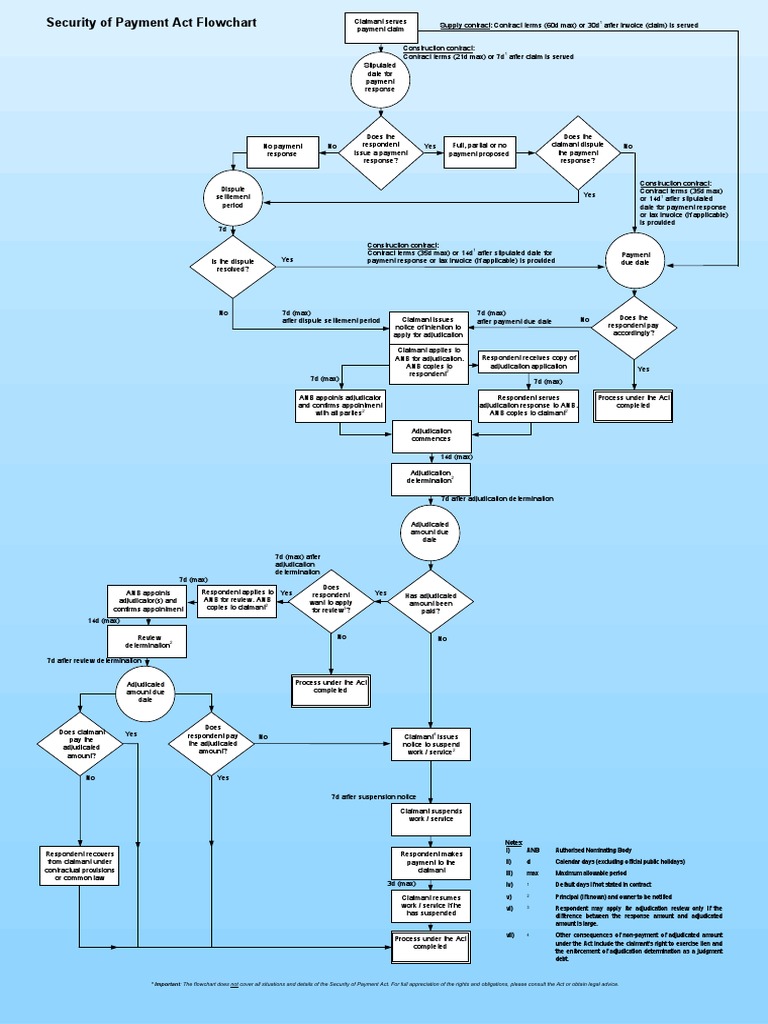
Figure: Overview of the Security of Payment Act payment claim, dispute settlement, adjudication and subsequent payment process.
The flowchart is intended as a general guide and does not cover every situation or detail under the Act. Applicable deadlines, notice requirements and procedural conditions should be checked against the relevant legislation and contract.
Claims should be supported by clear records, including measurements, progress reports, valuation breakdowns and contractual references. Missing deadlines or failing to comply with procedural requirements may affect a party’s position.
What Is Adjudication Under SOPA?
Adjudication is an expedited statutory mechanism for resolving qualifying payment claim disputes without immediately pursuing full court proceedings.
Singapore’s BCA explains that an independent adjudicator determines impartially the amount payable for a claim under the Act. The process is intended to be quick and relatively low-cost.
Adjudication may be relevant where parties disagree over:
- Interim payment certification and work valuations.
- Variation claims and additional work.
- Deductions, set-offs and backcharges.
- Contractual payment entitlements.
An adjudication determination is generally binding, subject to the Act and applicable review or court procedures. It does not necessarily provide the final resolution of every underlying contractual dispute.

Picture by Mikhail Nilov on Pexels
How Do Quantity Surveyors Help Manage Payment Risks?
Quantity surveyors (QS) support payment assessments through structured commercial and valuation analysis, helping improve the accuracy and transparency of progress payment claims.
Their responsibilities may include:
- Measuring and valuing completed construction work.
- Reviewing variation claims and supporting records.
- Checking quantities, rates and calculations.
- Reconciling payment claims against previous certifications.
- Identifying potential over-certification and underpayment risks.
- Organising supporting documents for negotiations or adjudication.
For example, a subcontractor may claim additional payment for variations, while the main contractor disputes the quantities or rates. A QS can review instructions, measurements, site records and applicable contract rates to establish a reasoned assessment. However, valuation alone does not establish every question of contractual entitlement. Notice requirements, claim procedures and contract terms must also be considered.
Practical Steps to Reduce Construction Payment Disputes
Effective payment management begins before disagreements arise. Construction businesses should establish clear procedures for:
- Contract administration: Understand payment terms and notice requirements.
- Document control: Maintain instructions, delivery orders and site records.
- Payment assessments: Review claims consistently and provide substantiated responses.
- Cash flow forecasting: Anticipate payment cycles and financial commitments.
- Dispute management: Address differences early through commercial discussions and suitable resolution mechanisms.
These practices are useful in Singapore and internationally, particularly where complex supply chains create payment risks.
Conclusion
Singapore’s Security of Payment Act provides an important framework for protecting construction cash flow and addressing payment disputes. However, effective use depends on understanding contractual rights, statutory procedures and deadlines. With proper quantity surveying, payment assessment and construction claims management, project stakeholders can improve payment transparency, manage financial exposure and resolve disputes more efficiently.
Contact us and find how our Contract & Dispute Advisory Services can help.
Frequently Asked Questions
What is the main purpose of the Security of Payment Act?
Answer: The Act aims to improve construction industry cash flow by providing statutory rights to progress payments and a mechanism for resolving payment disputes.
Who can make a payment claim under SOPA?
Answer: Eligible parties who have carried out construction work or supplied qualifying goods or services under a covered contract may make payment claims, subject to statutory requirements.
Does SOPA apply to all construction projects?
Answer: No. Its application depends on the contract, project circumstances and statutory exclusions. Certain residential property contracts, for example, may fall outside its scope.
What happens if a contractor disputes a payment claim?
Answer: The respondent should assess the claim and issue a compliant payment response within the applicable timeframe, stating the response amount and reasons for withholding payment where required.
Is adjudication the same as arbitration?
Answer: No. SOPA adjudication is an expedited statutory payment dispute mechanism. Arbitration is a separate dispute resolution process governed by its applicable agreement and legal framework.
How can quantity surveyors help with SOPA claims?
Answer: Quantity surveyors can assist with measurement, valuation, payment assessments, variation analysis, supporting documentation and commercial reviews for payment disputes.
Can an adjudication determination be challenged?
Answer: There may be statutory review procedures and limited grounds for court challenges, subject to applicable legal requirements. Parties should seek legal advice on their circumstances.
References
- Building and Construction Authority (BCA) – Security of Payment Act
https://www1.bca.gov.sg/growth-and-transformation/procurement/procurement-and-legal-frameworks/security-of-payment-act/ - Singapore Statutes Online – Building and Construction Industry Security of Payment Act 2004
https://sso.agc.gov.sg/Act/BCISPA2004 - Singapore Statutes Online – Building and Construction Industry Security of Payment Regulations
https://sso.agc.gov.sg/SL/BCISPA2004-RG1 - Singapore Courts, eLitigation – Asia Grand Pte Ltd v A I Associates Pte Ltd [2023] SGHC 175
https://www.elitigation.sg/gd/s/2023_SGHC_175 - Singapore Academy of Law, Asian Journal of Comparative Law / Asian Legal Information Institute resource – Singapore’s Security of Payment Act overview, Centre for Asia-Pacific Construction Law (CACJ)
https://cacj-ajp.org/singapore/legal-system/singapore-laws/key-legislation/building-and-construction-industry-security-of-payment-act/ - Singapore Parliament – Building and Construction Industry Security of Payment (Amendment) Bill 2018
https://www.parliament.gov.sg/docs/default-source/default-document-library/building-and-construction-industry-security-of-payment-%28amendment%29-bill-38-2018.pdf