dk@dkoutsource.com


In the construction industry, success is rarely the result of chance. It’s built on careful planning, well-coordinated execution, as well as accurate cost forecasting. This process of forecasting isn’t simply a financial exercise but a strategy that determines whether projects are delivered on time, within budget, and to the satisfaction of stakeholders. In today’s competitive market where margins are tight and risks are high, the ability to forecast costs with precision has become quite an important factor in project outcomes.
Why Accurate Cost Forecasting Matters
Cost forecasting as the work involved in estimating or predicting future conditions and events. It also states that, when applied to resource requirements, forecasting is effectively synonymous with cost estimating. -AACE International Library
Accurate cost forecasting is important because it provides an idea on the costs of construction projects. This means that it allows project managers to anticipate expenses, allocate resources efficiently, and be prepared for potential risks. Without it, projects are vulnerable to overruns, disputes, and delays. When there’s effective budget management, it ensures that financial resources are allocated wisely which helps to prevent overspending and at the same time enables proactive adjustments. Additionally, forecasting also plays a critical role in risk mitigation, identifying potential cost fluctuations early so that contingency plans can be implemented before issues escalate.
Likewise,the impact on stakeholder confidence is equally as important. Transparent forecasts build trust with clients, investors, and contractors which creates stronger collaboration and reduces the likelihood of disputes. Reliable forecasts also empower leaders to make informed decisions about design, procurement, and resource allocation.
Benefits for Project Outcomes
Cost Prediction is a process involving the inputs, analysis and outputs needed to produce an accurate, consistent and reliable prediction of capital or life-cycle costs based on the information available. -RICS
The impact of accurate cost forecasting goes beyond numbers on a financial spreadsheet. It directly shapes the quality and sustainability of project outcomes. Projects that adhere to the forecasted budgets would have good control over their finances, meaning that there’s a lesser risk of stalled progress. The forecasts created also enhance resource allocation, ensuring that labor, materials, and equipment are distributed efficiently and resources aren’t wasted.
Another significant benefit is the reduction of disputes. Clear financial expectations minimise conflicts between stakeholders over costs and scope changes. This not only saves time and money but also makes relationships better within the project team. Additionally, firms that consistently deliver projects within budget gain a competitive advantage, building reputational strength and client loyalty.
Challenges in Cost Forecasting
Despite its importance, accurate cost forecasting doesn’t come without challenges. One of the largest issues faced is the consistent fluctuating material costs which is driven by global supply chain volatility. Projects that rely on imported materials are constantly vulnerable to sudden price changes. On top of that, another challenge is project scope changes. Design modifications due to client requests or regulatory requirements can also lead to unexpected expenses that must be incorporated into forecasts.
Data quality has a critical role as well, because incomplete or inaccurate data reduces forecast reliability, making it difficult to predict accurate outcomes. Also, communication gaps between stakeholders can distort financial projections, leading to misunderstandings and disputes.

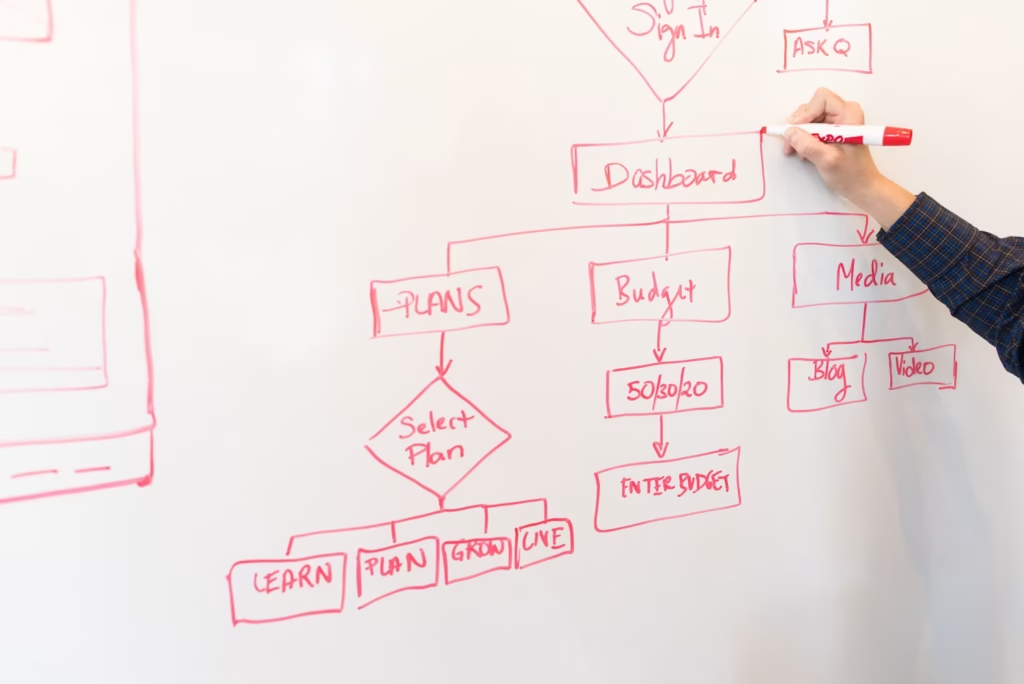
Picture by Pavel Danilyuk on pexels
The Role of Technology
Modern forecasting increasingly relies on AI and machine learning to analyze complex datasets and predict outcomes with greater accuracy. These technologies capture nonlinear relationships and dynamic fluctuations that traditional methods struggle to address. Predictive analytics, for example, identifies risk ranges and decision points before issues escalate, while digital twins and BIM (Building Information Modeling) provide real‑time insights into design and cost implications.
Closing Thoughts
The impact of accurate cost forecasting on project outcomes cannot be overstated. It drives financial stability, reduces risks, and enhances stakeholder trust — ultimately determining whether a project succeeds or fails. In an industry where projects are becoming increasingly complex, having a clear understanding of potential costs allows teams to respond with confidence rather than react to unexpected challenges.
References
- Construction Executive. Predictive Analytics and Forecasting in Construction Projects. May 28, 2026.https://www.constructionexec.com/article/predictive-analytics-and-forecasting-in-construction-projects
- Zhang, W. (2026). Applications of Machine Learning and Artificial Intelligence in Construction Project Cost Prediction: A Scientometric Analysis and Qualitative Review. https://www.frontiersin.org/journals/built-environment/articles/10.3389/fbuil.2026.1867673
- Odoo. n.d. “Construction, July19, 2026 https://www.odoo.com/industries/construction