dk@dkoutsource.com


Summary: Terminating a construction contract is rarely as simple as deciding that a project is no longer working. Under the Singapore Institute of Architects (SIA) Building Contract 2016, contract termination is governed by specific contractual rights, express grounds, and strict procedural mechanisms. Frustration with slow progress or commercial disputes is not, by itself, a valid legal basis for contract termination. Exercising a termination right incorrectly can expose the terminating party to claims for repudiatory breach and substantial financial liability. To mitigate risk, employers, contractors, and consultants must follow systematic contractual procedures, build a comprehensive evidentiary paper trail, and engage quantity surveyors early to secure the financial position.
Contractual Grounds vs. Common Law Repudiation
A fundamental distinction exists between exercising an express contractual right to terminate and accepting a repudiatory breach under general contract law:
- Common Law Repudiation: Arises when a party demonstrates a fundamental refusal or inability to perform its obligations. As established in RDC Concrete Pte Ltd v Sato Kogyo (S) Pte Ltd, common law termination rights arise upon an express contractual entitlement, renunciation by the other party, breach of a vital condition, or a breach that deprives the innocent party of substantially the whole contractual benefit.
- Contractual Termination: Governed by express terms within the contract suite. Terminating under contractual provisions does not automatically equate to common law repudiation, and the contractual process must be strictly adhered to.
Termination Provisions Under the SIA Building Contract 2016
The SIA Building Contract 2016 is available in several standard forms, including Without Quantities, With Quantities, and Design & Build. In the SIA 2016 Without Quantities form, termination and dispute mechanisms are governed by specific clauses:
| Clause | Scope & Subject Matter | Core Application |
| Clause 32(1) | Employer Termination Without Default | Grants an express right for the employer to terminate without contractor default under specific form conditions. |
| Clause 32(2)–32(4) | Employer Termination for Default | Establishes express contractual grounds, notices, and procedures for employer termination due to contractor default. |
| Clause 33 | Contractor Termination & Suspension | Sets out specific grounds and notice procedures enabling the contractor to suspend works or terminate. |
| Clause 37 | Arbitration | Governs formal arbitral dispute resolution mechanisms. |
| Clause 38 | Mediation | Framework for amicable alternative dispute resolution prior to formal proceedings. |
Procedural Rigour: The 6-Step Systematic Execution Checklist
Exercising a right to terminate requires systematic procedural compliance rather than immediate physical action:
- Identify the Contractual Ground: Confirm the precise clause relied upon and verify that all factual preconditions are met.
- Check Notice Requirements: Verify notice recipients, mandatory service methods, precise wording, and required cure periods.
- Build the Evidentiary Trail: Compile contemporaneous records including written site instructions, payment applications, formal correspondence, progress reports, programme updates, and defect logs.
- Check the Financial Position: Determine total amounts certified to date, outstanding payment claims, retention sums held, executed variations, and potential damages.
- Plan the Handover: Establish protocols for site repossession, material inventories, equipment protection, subcontractor novation/commitments, and security of ongoing works.
- Preserve Dispute Rights: Ensure that terminating the employment of the contractor does not forfeit outstanding claims or dispute resolution rights.
The SIA Contract Termination Workflow
| Phase | Details | Phase | Details |
| 1. Identify Contractual Ground | Confirm specific clause terms and verify preconditions. | 2. Verify Notice Requirements | Check recipient details, service methods, and cure periods. |
| 3. Build the Evidentiary Trail | Compile site diaries, progress reports, and instructions. | 4. Audit the Financial Position | Establish certified sums, retentions, and variations. |
| 5. Execute Site Handover Plan | Secure site, equipment, plant, and materials on site. | 6. Preserve Dispute Rights | Ensure post-termination payment and delay claims remain open. |

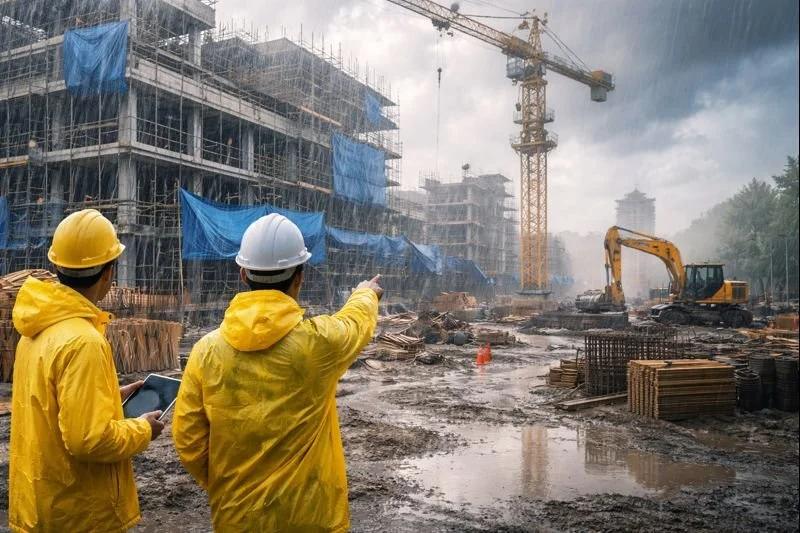
Picture by ANTONI SHKRABA production
Notice Precision & Legal Precedents
A termination notice is a critical formal instrument and must never be treated as routine project correspondence. The notice must explicitly state the exact contractual basis relied upon and strictly comply with SIA procedural rules. As highlighted in cases such as HDB v Jurong Primewide Pte Ltd, courts examine contractual performance obligations and notice mechanics strictly. Misjudging a breach or serving a defective notice can result in the terminating party committing a wrongful repudiation.
Post-Termination Realities & The Role of the Quantity Surveyor
Termination marks the beginning of a complex accounting and operational process rather than the immediate end of the dispute.
Key Post-Termination Exposure Areas:
- Valuation of work properly completed prior to termination.
- Settlement of outstanding payment claims and release/withholding of retention money.
- Defect identification and cost of rectification by third parties.
- Title, ownership, and protection of on-site materials and equipment.
- Assessment of delay damages and total cost of completing remaining works.
- Subcontractor commitments and ongoing liabilities.
Interaction with the Security of Payment Act (SOPA):
Under Singapore law, payment issues continue to interact with the Building and Construction Industry Security of Payment Act (SOPA). SOPA expressly recognizes that statutory payment rights and adjudication mechanisms apply even after a construction contract has been terminated.
Strategic Value of the Quantity Surveyor (QS):
Engaging a Quantity Surveyor prior to and during termination is essential. A QS establishes the objective financial baseline by assessing completed works, evaluating variations, reviewing supporting site records, and auditing the final account balance.
Frequently Asked Questions
Can an employer terminate an SIA contract without contractor default?
Answer: Yes. Certain SIA forms contain an express right under Clause 32(1) permitting termination without contractor default, subject to specific contractual conditions.
Can a contractor terminate an SIA contract?
Answer: Yes. Clause 33 of the SIA Building Contract 2016 sets out specific grounds and notice procedures allowing the contractor to suspend work or terminate.
Is contractual termination the same as common law repudiation?
Answer: No. Contractual termination relies on specific provisions written into the contract, whereas repudiation occurs when a party fundamentally refuses or fails to perform its obligations under general contract law.
Does contract termination extinguish outstanding payment claims?
Answer: No. Payment rights and disputes survive termination. In Singapore, the Security of Payment Act (SOPA) provides a statutory adjudication route that explicitly applies even after a contract has been terminated.
Why should a Quantity Surveyor be involved before terminating?
Answer: A Quantity Surveyor evaluates the objective financial position, values completed works and variations, reviews site records, and prepares the documentation required for final accounts or dispute proceedings.
References
- Singapore Institute of Architects — SIA Building Contract 2016 and contract publications. https://store.sia.org.sg/contracts
- Singapore Law Watch — Building and Construction Law, termination and repudiation. https://www.singaporelawwatch.sg/Headlines/ch-26-building-and-construction-law
- Singapore eLitigation — 2004 SGHC 107, construction contract termination and repudiation. https://www.elitigation.sg/gd/s/2004_SGHC_107
- Building and Construction Authority — Security of Payment Act. https://www1.bca.gov.sg/growth-and-transformation/procurement/procurement-and-legal-frameworks/security-of-payment-act/
- Singapore Statutes Online — Unfair Contract Terms Act 1977. https://sso.agc.gov.sg/Act/UCTA1977
- Singapore Institute of Architects — SIA Conditions of Appointment and Architect’s Services, including termination provisions. https://sia.org.sg/wp-content/uploads/2024/03/SIA-Conditions-of-Appointment-And-Architects-Services-and-Mode-of-Payment-2022.pdf