Restoring Stability. Enhancing Accessibility.
From specialised construction requirements to careful cost management, the project required a coordinated approach to rectifying existing infrastructure while maintaining the operations of an active equestrian facility.
Employer: Singapore Turf Club
Structural Consultant: CPG Consultants Pte Ltd
Contractor: Chuan Oh Construction Pte Ltd
Conditions of Contract: Employer’s COC, Lump Sum
Sector: Commercial
Location: No. 1 Equestrian Walk, Riding Centre, Singapore
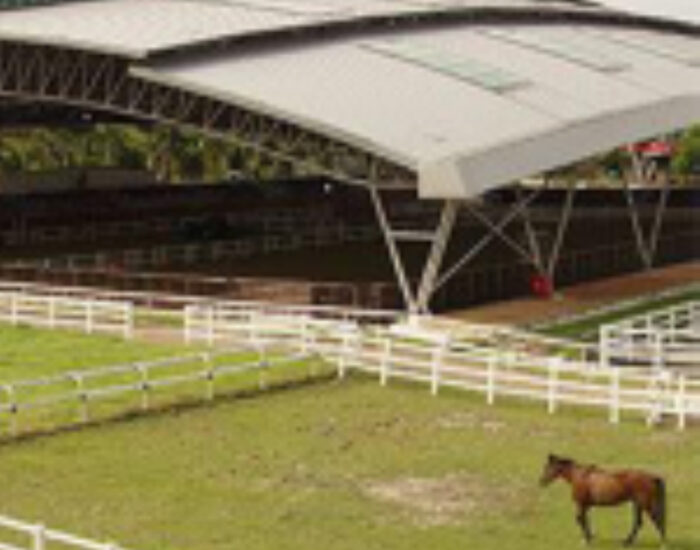
Rectifying Existing Infrastructure at an Active Equestrian Facility
The Singapore Turf Club Riding Centre Gabion Wall & Access Road @ 1 Equestrian Walk project on Lot 05695W MK 13, involved proposed rectification works to an existing gabion wall and uphill access road.
The project was delivered under a lump-sum, fixed-price contract with a six-month duration. The works involved the demolition and reconstruction of the existing gabion wall, rehabilitation of the uphill access road and various external works. At the same time, it also maintained the functionality and operational requirements of the surrounding equestrian facilities.
The project presented a combination of construction, environmental and operational considerations. Working within an active horse training and public area required stringent controls over noise, vibration, dust, cleanliness and working hours. In addition, planned use of the riding facilities for the SEA Games required careful consideration of the construction programme.
Reconstructing the Gabion Retaining Wall
A key component of the project involved demolishing the existing one-metre-wide upper-tier gabion wall and constructing a new flexible gabion retaining wall.
The proposed wall was approximately 50m long, 1.5m wide and 2m high. The works included the installation of drainage geo-composite, non-woven geotextile separators, UPVC perforated pipes and a compacted crusher run base to support the new structure.
The gabion units were required to be genuine Maccaferri 80mm woven wire mesh boxes, or an approved equivalent. This specified material requirement added an important procurement consideration to the works and required compliance with the project specifications.
From a commercial perspective, the defined construction requirements and specified materials needed to be considered within the lump-sum contract, particularly when assessing the scope and associated costs of the rectification works.
Reconstructing the Uphill Access Road
The existing uphill access road was also scheduled for demolition and reconstruction.
The new road was to comprise concrete rigid pavement conforming to LTA standards. The works included graded granite aggregate, geotextile membranes, concrete slabs, sand screed and asphaltic base and wearing courses.
The road reconstruction formed part of the wider infrastructure rectification works and required coordination with the retaining wall and associated external works.
Managing External and Associated Works
Beyond the main gabion wall and access road, the project included several associated external works.
These included the removal and installation of a reinforced concrete wall, new fencing, 1270mm-high PVC railings, a reinforced concrete drain and concrete road kerbs.
The reinforced concrete drain was required to match existing invert levels, requiring the new drainage works to be coordinated with the existing site conditions.
Together, these works required the project scope to be considered as an integrated package, with the various structural, road, drainage and external works coordinated within the overall construction programme.
Managing Demolition Restrictions and Construction Constraints
The demolition methodology presented a significant project consideration. Traditional hacking, ball and crane demolition methods were strictly prohibited.
Instead, the contractor was required to propose low-noise and low-vibration demolition methods, such as electric sawing, with the proposed methodology fully endorsed by a Professional Engineer.
These requirements were particularly important given the site’s proximity to active horse training and public areas. Construction activities therefore had to be carefully managed to minimise disruption while complying with the specified safety and operational requirements.
The contractor was also required to maintain a high standard of site cleanliness, including manual sweeping twice daily and the use of dust screens.
Working Around an Active Equestrian Facility
The project was carried out within the Singapore Turf Club Riding Centre, a world-class equestrian facility located next to the Singapore Racecourse in Kranji.
The operational environment created additional constraints for the construction programme. Works had to be planned around horse training activities and public use of the facilities, with measures implemented to minimise disruption.
Overtime works required two days’ written notice and prior approval from the Superintending Officer. These requirements meant that construction activities had to be carefully planned and coordinated. It had to balance project progress with the continued operation of the facility.
Managing Night Works and Operational Requirements
The project programme also had to take into account the planned stoppage of construction activities due to SEA Games use of the horse riding facilities.
To minimise interruptions to the facility’s operations, construction activities were carried out at night. This requirement was driven by the potential loss of revenue associated with disruption to the facilities.
The introduction of night works also created additional cost considerations. A cost-benefit analysis was conducted to assess the implications of the proposed arrangement, following which an adjustment to the tender bid was negotiated with the successful Contractor for the night works.
Environmental and Safety Requirements
The contractor was required to engage a Qualified Erosion Control Professional to prepare and submit Earth Control Measure (ECM) plans to PUB. Continuous Total Suspended Solids (TSS) water discharge monitoring was also required during the works.
Additionally, an approved pest control firm was required to manage vector breeding prevention, while dust control and site cleanliness measures were implemented to maintain suitable conditions around the active equestrian environment.
The project also required existing trees and plants to be preserved where possible. Where flora could not be reinstated, comparable replacements were required, subject to the Club’s approval. These requirements added further considerations to the planning and execution of the works where construction activities had to coexist with the surrounding landscaping.
Our Role
Our involvement focused on supporting the commercial management of the works and assessing the cost implications of the project’s various requirements, including the specialised construction methods, night works and associated external works.
The project presented a number of commercial considerations arising from its operational constraints. In particular, the requirement for night construction to accommodate SEA Games. The use of riding facilities required a cost-benefit analysis and negotiation of an adjustment to the tender bid with the successful Contractor.
Our service included:
Quantity surveying consultancy
Cost management
Tender and commercial assessment
Cost-benefit analysis
Contract administration support
Assessment of project requirements
Commercial coordination
Balancing Construction Requirements with Operational Needs
The Singapore Turf Club Riding Centre project demonstrates the importance of coordinating construction works within an active operational environment.
The rectification works involved substantial infrastructure works, including reconstruction of the gabion retaining wall and uphill access road, while the project also incorporated drainage, fencing, railings, kerbs and other external works.
At the same time, strict demolition restrictions, environmental controls, site cleanliness requirements and operational constraints had to be accommodated. The SEA Games schedule further required construction activities to be carried out at night, with the associated financial implications assessed and negotiated.
Through careful commercial assessment and coordination, the project requirements could be considered within the broader financial and operational context of the works.